
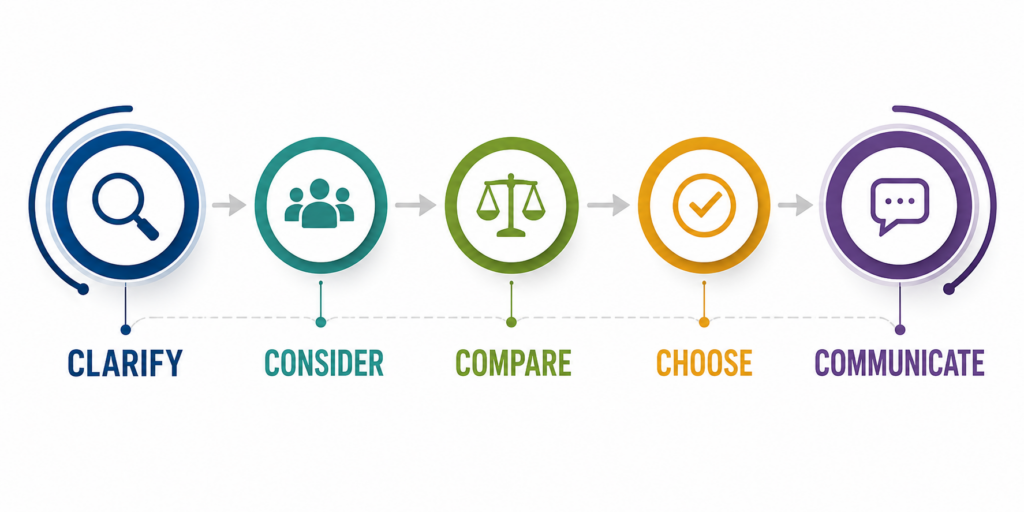
When people think about decision-making, they often focus on analysis: gathering facts, weighing options, calculating risks, and choosing the best path.
That matters, of course.
But in real organizations, especially fast-moving ones, many decisions do not break down because people failed to think. They break down because people failed to communicate.
The problem is often not just the quality of the decision itself. It is the lack of clarity around the decision and the lack of communication after it is made.
That is why two parts of strategic decision-making deserve more attention than they usually get: Clarify and Communicate.
They sound simple. They are not.
They are where confusion is reduced, alignment begins, and trust is either built or damaged.
Before going deeper, it helps to see the full decision-making framework in one place. Strategic decisions are not just about selecting the “best” option. They require leaders to define the decision clearly, gather and weigh the right input, compare trade-offs, make a choice with sound judgment, and communicate the outcome in a way people can understand and act on.
The infographic below summarizes that process.
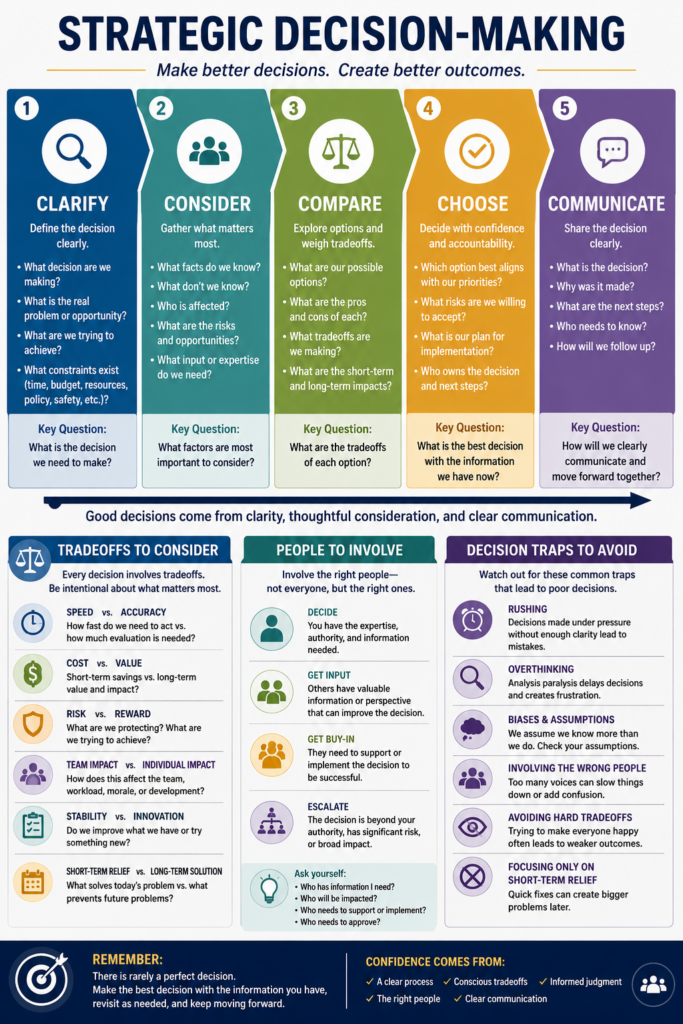
Decision-Making Infographic PDF
In the rest of this article, I want to focus especially on two parts of the framework that are often underestimated: Clarify and Communicate. These two steps are where decision-making and communication intersect most directly, and they often determine whether a decision creates alignment or confusion.
Clarify: Define the decision before you try to solve it
One of the most common leadership mistakes is trying to solve a problem before clearly defining the decision.
A conversation begins with, “What should we do?”
A meeting starts with, “We need to figure this out.”
A manager asks for input, but no one is sure what the real question is.
That creates wasted motion immediately.
People discuss symptoms instead of causes.
They debate solutions to different problems.
They jump to preferences before agreeing on the issue.
They leave the conversation thinking they aligned, when in fact they answered different questions.
Clarity requires slowing down long enough to ask:
- What decision are we actually making?
- What problem are we trying to solve?
- What outcome are we aiming for?
- What constraints matter here?
- What is in scope, and what is not?
This is not overthinking. This is leadership.
A well-defined decision creates focus. A poorly defined decision creates noise.
A communication problem disguised as a decision problem
Many decision failures are really communication failures in disguise.
A leader may think the issue is obvious. The team may hear three different priorities. One person believes the goal is speed. Another believes it is cost control. A third assumes the real concern is client satisfaction. Now everyone is working hard, but not in the same direction.
That is why strategic decision-making begins with language.
If you cannot state the decision clearly, your team will struggle to think clearly about it.
A useful test is this:
Can I explain the decision in one or two plain sentences?
For example:
- “We need to decide whether to accelerate this timeline, knowing it may increase pressure on the team and raise the risk of errors.”
- “We need to decide whether to standardize this process across teams or allow local flexibility.”
- “We need to decide whether this issue can be handled at our level or needs to be escalated.”
That level of clarity helps people engage the right question.
Clarify the tradeoffs, not just the options
Leaders often present decisions as if they are choosing between a good option and a bad one.
In reality, many important decisions involve choosing between competing goods, competing risks, or competing costs.
That is why another communication task inside Clarify is naming the tradeoffs.
What are we balancing?
- speed vs. accuracy
- short-term relief vs. long-term solution
- consistency vs. flexibility
- client responsiveness vs. internal capacity
- quick action vs. broader input
When leaders fail to name the tradeoffs, teams often argue in circles. Each person is defending a value, but no one has made those values visible.
Clear communication makes the tradeoffs discussable.
Communicate: A decision is not complete until it is understood
Some leaders believe their job ends when the decision is made.
It does not.
A decision has not really landed until the people affected understand:
- what was decided
- why it was decided
- what happens next
- what is expected of them
- what remains uncertain
- who owns the next steps
This is where many good decisions lose their value.
A sound decision, poorly communicated, still creates confusion.
People may comply without commitment.
They may misunderstand the reasoning.
They may fill in gaps with assumptions.
They may resist not because they oppose the decision, but because they do not understand it.
That is why strong leaders do not just make decisions. They translate them.
Communicating a decision with clarity
Strong decision communication does not need to be dramatic. It needs to be clear.
A simple structure can help:
Here’s the decision.
Here’s why we made it.
Here’s what it means.
Here’s what happens next.
For example:
“We’ve decided to delay the rollout by two weeks. We made that call because the current process is creating too much confusion, and moving ahead now would increase rework. For the team, that means we will use this time to tighten the handoff process and clarify responsibilities. I’ll meet with each group this week to confirm next steps.”
That kind of communication reduces uncertainty and builds confidence.
The communication mistake leaders make after deciding
A common mistake is assuming that once something has been said once, it has been communicated.
In reality, important decisions usually need to be reinforced.
People need repetition, especially when:
- the decision affects workflow
- emotions are involved
- priorities are shifting
- different groups are affected differently
- uncertainty still exists
Leaders sometimes worry that repetition sounds excessive. Usually, it sounds like leadership.
If the decision matters, repeat the message in different forms:
- in the meeting
- in follow-up notes
- in one-on-one conversations
- in check-ins
- in reminders tied to action
Not because people are not listening, but because clarity under pressure often takes reinforcement.
Communication builds trust in decision-making
When people do not understand a decision, they often question the decision-maker.
When they do understand it, they may still disagree, but they are more likely to see the process as thoughtful and fair.
That matters.
Trust is not built only when people like the decision. Trust is built when leaders communicate decisions with clarity, consistency, and respect.
That includes:
- naming what you know
- acknowledging what you do not know yet
- being honest about tradeoffs
- avoiding vague language
- making ownership clear
- following up
People can handle difficult decisions better than many leaders think. What they struggle with is ambiguity, mixed messages, and silence.
Strategic communication is not just presentation skill
Sometimes, communication is treated as a soft layer added after the “real thinking” is done.
But in decision-making, communication is part of the thinking.
Clarifying the decision sharpens judgment.
Naming the tradeoffs improves discussion.
Communicating the reasoning builds alignment.
Explaining next steps increases execution.
This is not cosmetic. It is operational.
A decision that is not clear will not travel well.
A decision that is not communicated will not be implemented well.
Questions leaders should ask themselves
Before the decision:
- What decision are we actually making?
- Am I solving the right problem?
- What tradeoffs need to be named?
- Who needs input before I decide?
After the decision:
- Have I stated the decision clearly?
- Have I explained the reasoning in plain language?
- Do people know what this means for them?
- Is ownership clear?
- What needs to be repeated or reinforced?
Final thought
Better decisions do not start with smarter spreadsheets or stronger opinions.
They start with clarity.
And they gain traction through communication.
If you want better outcomes, do not just ask whether the decision was smart.
Ask:
- Was the decision clear?
- Were the tradeoffs visible?
- Was the communication strong enough to create alignment and action?
Because in leadership, a good decision is only as strong as the clarity behind it and the communication that carries it forward.