
Most people think of presentations as something to prepare for… deliver… and move on from.
A meeting.
A team update.
A conference talk.
A Toastmasters speech.
You prepare. You deliver. You check it off.
And then it’s over.
But there’s a different way to think about your speaking.
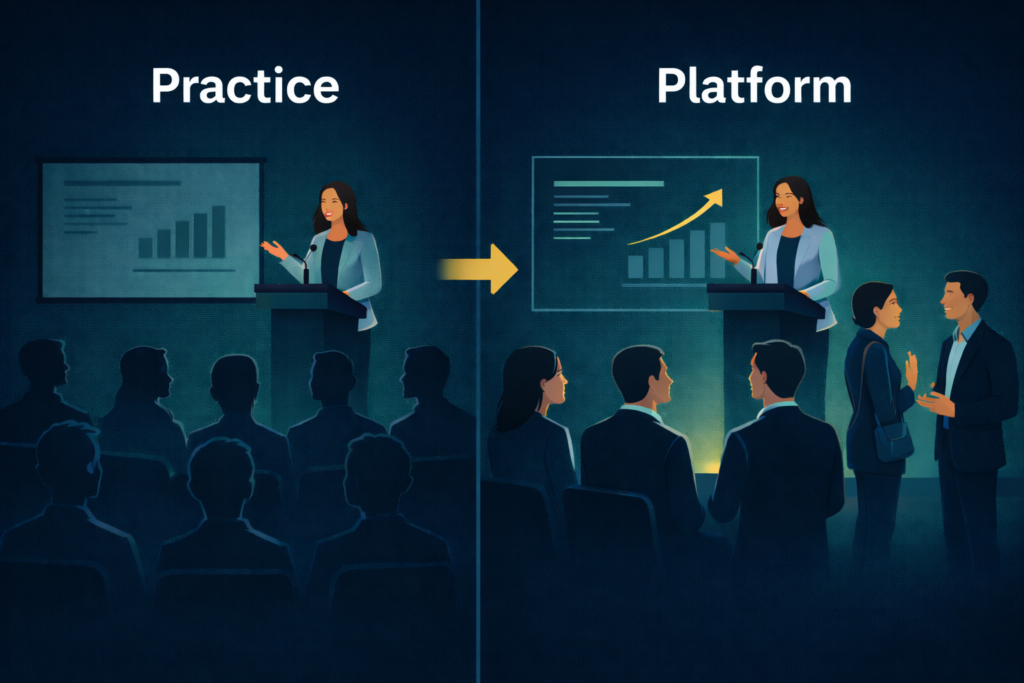
Every talk is either practice… or positioning.
What Practice Thinking Looks Like
Practice thinking is focused on the moment.
“I need to deliver this well.”
“I want my slides to be clear.”
“I hope this goes smoothly.”
There’s nothing wrong with that.
In fact, it’s how most people learn to become good speakers.
But the focus stays on the performance itself.
Once it’s over, it’s over.
No follow-up.
No continuation.
No momentum.
What Positioning Thinking Looks Like
Positioning thinking goes one step further.
It asks:
“What could this lead to?”
Not just:
“How do I deliver this well?”
But:
“How do I use this to create something beyond this moment?”
For example:
In a corporate setting, instead of thinking:
“I need to present this update clearly.”
You might think:
“I want leadership to see me as someone who thinks strategically and drives outcomes.”
In Toastmasters, instead of thinking:
“I’m giving a speech for my next project,”
You might think:
“I’m developing a talk I could use outside this room—something people remember and talk to me about afterward.”
Same talk.
Different intention.
Very different outcome.
The Shift That Changes What Happens After You Speak
This shift doesn’t require a completely different presentation.
It requires a different level of intention.
When you think in terms of positioning:
- You shape your message more deliberately
- You consider how you’re perceived
- You become more intentional about your close
Because you’re not just asking:
“Did this go well?”
You’re asking:
“What did this create?”
A conversation?
A decision?
An opportunity?
A Simple Way to Apply This
Before your next talk, ask yourself one question:
What do I want this to lead to?
Be specific.
Not:
“Do a good job.”
But:
“Help leadership see me as someone who thinks strategically.”
“Gain buy-in for this idea.”
“Create momentum for the next step.”
For example, let’s say you’re giving a project update.
If you’re in practice-thinking mode, your focus might be:
“I need to give a clear update on our project.”
But if you’re in platform-speaking mode, your focus becomes:
“I want leadership to see me as someone who thinks strategically and drives outcomes.”
That changes how you prepare.
You include less detail dumping.
You do more framing: “Here’s what matters most…”
And you create a clear takeaway: “Here’s the decision we need…”
Instead of ending with:
“Any questions?”
You might end with:
“Based on this, here’s the decision we need to make, and here’s my recommendation.”
Same update.
Different intention.
Very different result.
That clarity changes how you prepare—and how your audience experiences your message.
Why This Matters
If you’ve ever given a presentation that went well—but didn’t lead anywhere—this may be why.
You treated it as a moment.
Not as a platform.
And that’s a missed opportunity.
Because every time you speak, people are deciding:
Do I remember this person?
Do I trust them?
Would I want to hear from them again?
A Small Shift with Big Impact
You don’t need more speaking opportunities to grow your impact.
You need to get more from the ones you already have.
Every talk is either practice… or positioning.
The difference is what you decide to make it.