If you’ve ever thought, “I’d use AI more… if I knew what to ask,” you’re not alone. Good results start with better prompts, and that’s exactly why I created The Clarity Code AI Prompt PowerPack. Clear prompts lead to clear thinking, clearer messages, and much better output.
What surprises people is how dramatically the results improve when you give AI a well-designed, clarity-focused prompt—one that guides the tool to think the way you think.
So today, I want to show you what that looks like in action.
Before I share the full conversation I had with ChatGPT, I want to give you all ten prompts from the PowerPack. That way, when you read the example, you’ll see exactly which prompt I used, why it worked, and how you can use the same approach in your own communication.
The 10 Prompts in The Clarity Code AI Prompt PowerPack
These are the prompts included in the PowerPack PDF (get the actual prompt in the PDF). You can copy, paste, and use them immediately to clarify, simplify, and sharpen your message.
The Clarity Code AI Prompt Power Pack summary:
- The Clarity Compass Prompt
Distill any idea down to one clear message. - The Audience Decoder Prompt
Tailor your message to any audience. - The Simplify-Without-Dumbing-Down Prompt
Keep nuance, remove noise, clean up intellectual clutter. - The Structure-Is-Your-Superpower Prompt
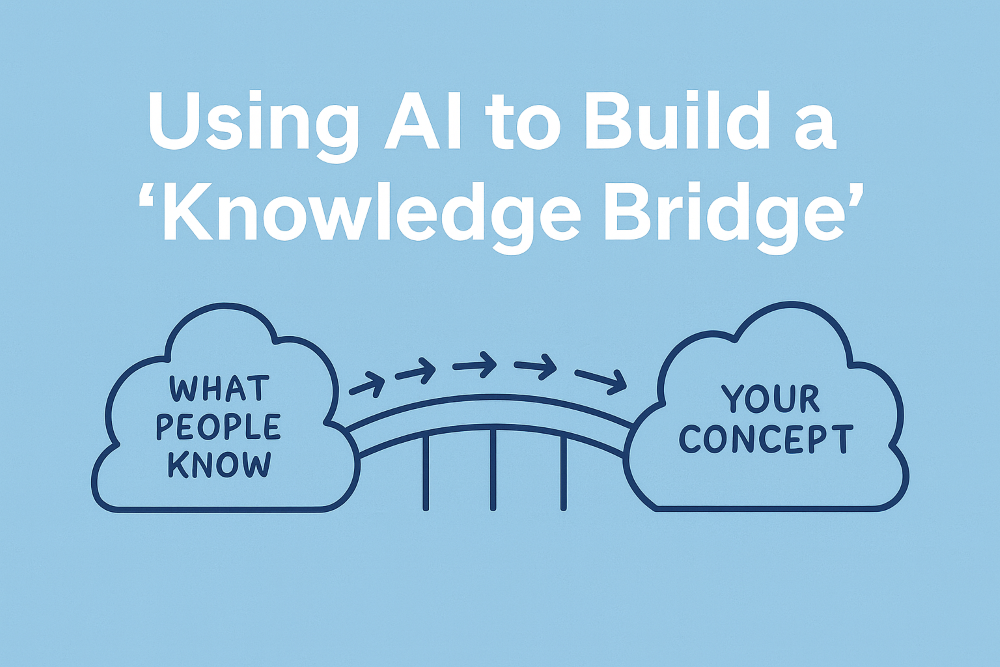
Turn any idea into a clear, logical structure. - The Knowledge Bridge Builder Prompt
Prevent the Curse of Knowledge by building an easy on-ramp. - The Analogy Generator Prompt
Create simple, fresh, accurate analogies—avoid clichés. - The Story Spark Prompt
Generate short, vivid stories that illustrate your point. - The Visual Clarity Prompt
Turn ideas into simple slides, sketches, or diagrams. - The 3-Level Explainer Prompt
Explain anything at three depths: novice, intermediate, expert. - The Clarity-in-Writing Editor Prompt
Instantly improve clarity, structure, and readability.
Download the full PowerPack HERE.
Now for the Fun Part: My Full Conversation with ChatGPT
Here’s the complete exchange where I used Prompt #5—the Knowledge Bridge Builder—to explain something familiar but often difficult to describe simply: A Toastmasters club.
My full conversation is below, exactly as it unfolded:
Explain my concept as a knowledge bridge. Start with what most people already know, then build one small step at a time. Avoid jargon, use plain language, and check for assumptions I might be making. Concept: A Toastmasters Club
ChatGPT said:
Thought for 12s
Imagine you’re explaining this to someone who’s never heard of Toastmasters.
Step 1: Start with what they already know
Most people already know three things:
- Talking in front of a group can feel scary or awkward.
- Practice usually makes any skill easier.
- A “club” is a group of people who meet regularly around a shared interest.
We’ll build from just those three ideas.
Step 2: Connect to a familiar idea
You might say:
“Toastmasters is like a gym, but for public speaking and communication.”
People understand the idea of a gym:
- You don’t get fit by reading about exercise.
- You go regularly.
- You work out with other people.
- You improve a little at a time.
That’s the same basic idea behind a Toastmasters club.
Step 3: What actually happens in a Toastmasters club?
Next step, still simple and concrete:
“A Toastmasters club is a group of people who meet regularly to practice speaking and giving feedback in a friendly setting.”
You can add a bit more:
- Members take turns giving short prepared talks.
- Others practice listening and then give helpful feedback.
- Some members practice thinking on their feet by answering surprise questions.
- Everyone gets a chance to try different “jobs” in the meeting, like timekeeper or meeting leader.
So it’s not just talking. It’s also:
- Listening
- Encouraging others
- Leading a meeting
All in small, repeatable steps.
Step 4: Why do people join?
Now you connect it to everyday reasons:
“People join Toastmasters because they want to feel more confident speaking—at work, in community groups, in school, or even at family events.”
Common goals:
- Give better presentations at work
- Speak up more in meetings
- Tell clearer stories
- Reduce nervousness
- Build leadership skills by leading meetings and projects
You don’t have to want to be a professional speaker. Most members just want to communicate more clearly and confidently in everyday life.
Step 5: What makes it different from a class?
Another small step:
“It’s not a class with a teacher at the front. It’s run by the members themselves.”
Key idea:
- Everyone is both a learner and a helper.
- You learn by doing, not just by listening.
- You improve over time, because you keep coming back and practicing.
You might compare:
- A class = learn mostly from a teacher.
- A Toastmasters club = learn mostly from doing and from each other.
Step 6: Summarize the bridge in one sentence
Once you’ve walked them across the “bridge,” you can give a simple summary:
“So, a Toastmasters club is a member-run speaking gym where people meet regularly to practice communication and leadership in a safe, supportive environment.”
Step 7: Check for assumptions you might be making
Here are a few assumptions you might accidentally make when you explain Toastmasters, and how to watch for them:
- Assuming people know what Toastmasters is.
- Better: Start with “It’s a public speaking and communication club” before using the name.
- Assuming everyone wants to be a “speaker.”
- Better: Emphasize everyday situations—meetings, interviews, conversations, toasts—not just “speeches.”
- Assuming they understand the idea of “roles” or “evaluations.”
- Instead of “meeting roles,” say “small jobs people take on during the meeting.”
- Instead of “evaluations,” say “kind, specific feedback to help you improve.”
- Assuming it sounds too formal or scary.
- Balance it with words like “friendly,” “supportive,” “practice,” and “small steps.”
If you’d like, I can turn this into a short script you could use when someone asks, “So… what’s Toastmasters?”
You said:
yes
ChatGPT said:
Here’s a short, natural-sounding script you can use when someone asks, “So… what’s Toastmasters?”
It follows your knowledge bridge style—starting from what they already know and building up one small step at a time.
Simple Script: Explaining a Toastmasters Club
“Most people feel a little nervous speaking in front of a group, and we all know practice usually makes things easier. A Toastmasters club is basically a friendly place to practice communicating—kind of like a gym, but for public speaking and leadership.
We meet regularly, and members take turns doing small things: giving short talks, trying a quick ‘think-on-your-feet’ question, or taking one of the simple jobs that help the meeting run. After someone speaks, another member gives supportive, specific feedback so everyone gets better a little at a time.
People join for everyday reasons—being clearer at work, speaking up in meetings, telling better stories, or just feeling more confident. It’s not a class with a teacher; it’s members helping each other grow in a really encouraging setting.
So in a nutshell: Toastmasters is a supportive practice group where you build confidence, communication skills, and leadership step by step.”
If you’d like, I can also create:
- A shorter elevator version (10–15 seconds)
- A longer version for presentations or open houses
- A version tailored to professionals, college students, or nervous newcomers.
Just tell me what you need.
You said:
Give me the shorter version
ChatGPT said:
Here’s a short, clean elevator version:
“Toastmasters is like a gym for communication. It’s a friendly club where people practice speaking, listening, and leading through short, simple activities. You get supportive feedback, build confidence, and improve a little each time you come.”
What This Shows
This example highlights something important:
- AI doesn’t magically know how to explain things simply.
- Your prompt shapes the path.
- When you guide AI to start with what people already know and build step-by-step, you get a clear explanation that makes sense to almost anyone.
What I love about this prompt is how it forces clarity—no jargon, no shortcuts, no assumptions. It builds knowledge the same way a teacher or coach would.
If you’ve ever struggled to explain a concept, especially to people outside your field, this prompt can be a game-changer.
Final Thoughts
AI is most powerful when you know how to guide it. You don’t need more tools—you need better prompts. The ten prompts in the PowerPack are designed to help you clarify ideas, simplify messages, and create communication that people understand the first time they hear it.
If you’d like your own copy of the PowerPack, you can download it HERE
If you try one of the prompts, I’d love to hear what you create.
And you can explore more clarity techniques in my book, The Clarity Code: Communicate Complex Ideas with Simplicity and Power.