
Earlier this month, I had the opportunity to substitute as the facilitator for a mastermind group I participate in regularly. Normally, our meetings feature a scheduled speaker on a business-related topic, but this time, there was no advance plan.
Rather than cancel or scramble, I designed a new meeting format.
The result? Everyone participated. Everyone contributed. Everyone left with new ideas and a sense of support. It worked so well that I wanted to share the structure in case you’re part of a group, or thinking of starting one, that could benefit from a mastermind model that doesn’t rely on pre-planned presentations.
Why Masterminds Matter
A mastermind group is more than a meeting. It’s a built-in circle of support, insight, and accountability. When you’re growing a business, leading a project, or navigating big goals, the journey can feel isolating.
A good mastermind group provides:
- Fresh perspectives on your challenges
- Encouragement from peers who “get it”
- Constructive feedback without the fluff
- A structure to keep you focused and moving forward
Personally, I’ve found that masterminds give me clarity, encouragement, and practical solutions—especially when I didn’t even know what I needed going in.
Mastermind Meeting Format (1 Hour, ~8 People)
This is the structure I used—and it’s designed to work even when no one comes with a prepared topic:
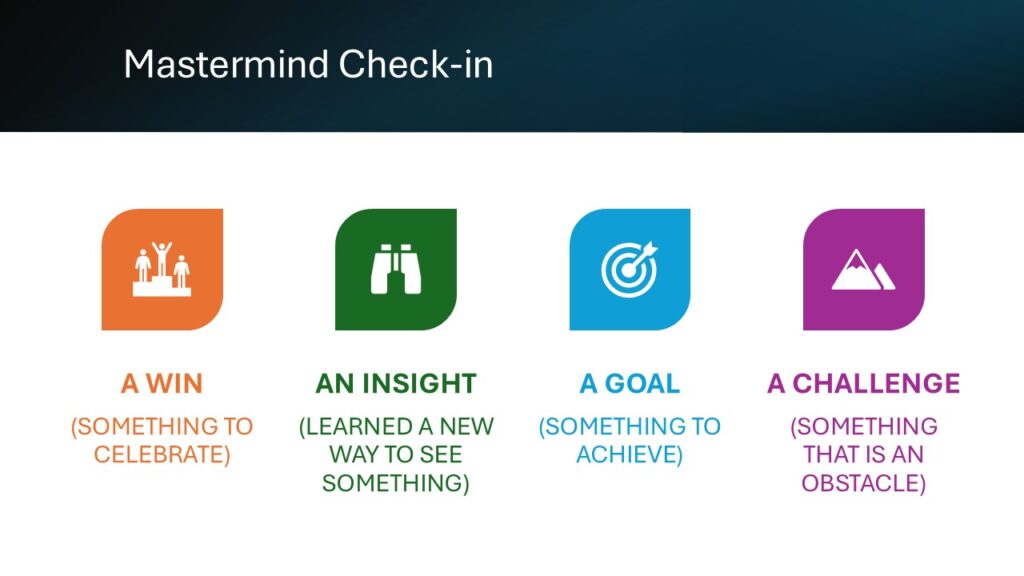
1. Group Check-In (24 minutes) Each person briefly shares 4 items:
- A recent win
- An insight
- A goal
- A challenge they’re currently facing
Limit: 3 minutes per person
The facilitator writes down each challenge as it’s shared
Here’s the Master Mind Check-In PowerPoint that I used for the group, which met on Zoom. I shared the first slide to keep people on track for the 4 items each shared, while I noted on the second slide each person’s name and challenge as they spoke (I didn’t share this second slide until later).
2. Paired Conversations (10 minutes) Participants split into pairs to dig deeper into their challenges and explore ideas together (breakout rooms on Zoom). This one-on-one time builds connection and sparks creativity.
3. Solution Sharing (16 minutes)– Everyone returns to the full group and shares ideas or insights that emerged from their pair conversation (approximately 2 minutes each). The facilitator notes key takeaways.
4. Additional Feedback (8 minutes) Time is set aside for anyone to offer extra thoughts or resources. Alternatively, the facilitator can spotlight one particularly sticky challenge and open it to group brainstorming.
5. Wrap-Up (2 minutes) The facilitator summarizes the key challenges and solutions shared, and encourages members to take one idea forward before the next meeting.
How to Start or Strengthen a Mastermind
- Meet Monthly: Enough time for progress and reflection, not so much time that people disconnect.
- Choose the Right People: Look for individuals who are curious, growth-minded, and reliable.
- Keep It Focused but Flexible: This format works as a default, but can adapt to guest speakers, themed sessions, or open discussions.
- Use a Simple Visual: (Optional) A shared screen with a slide or worksheet to record challenges and ideas keeps the meeting grounded.
This format turned an “unplanned” meeting into one of the most engaging, useful, and inclusive sessions our group has had in a while.
If you’re craving connection and clarity in your business or creative work, I encourage you to try it, whether with your current group or by starting one of your own.