
What happens when the message you send isn’t the message people receive?
A Michigan credit union CEO recently learned just how large that gap can become.
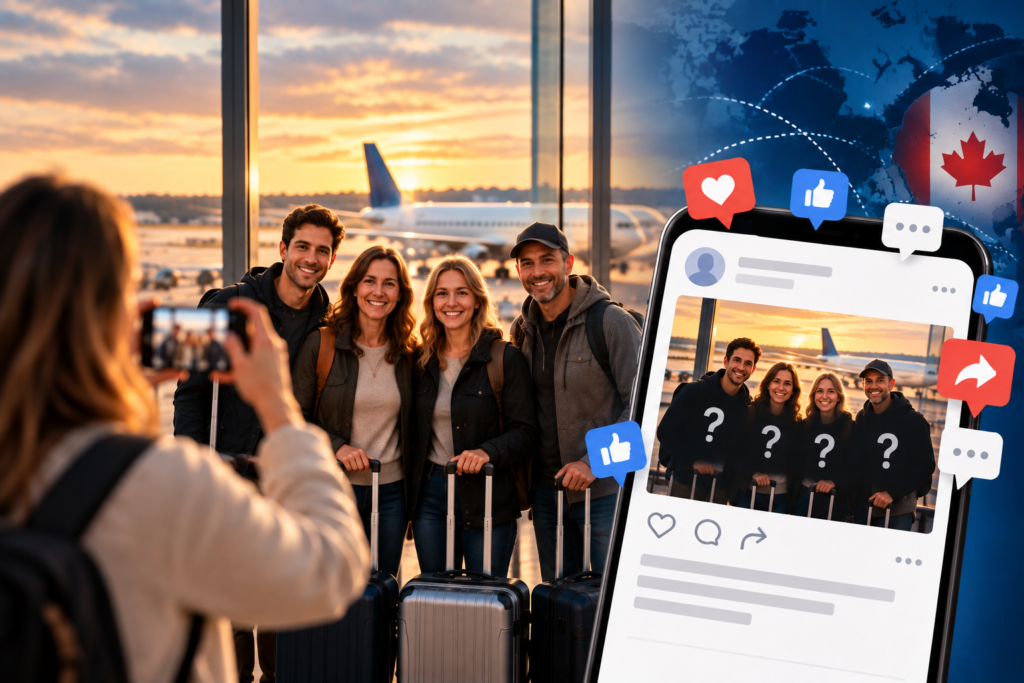
Jane Smith, then CEO of Family First Credit Union, was traveling with family to Halifax, Nova Scotia. Before their flight, the family took a photo at the Detroit airport.
Then they decided to have a little fun with AI.
President Trump had recently ordered U.S. federal agencies to refer to Lake Ontario as “Lake America,” a move that had generated considerable controversy in Canada. Smith used ChatGPT to alter the family photo so it looked as though everyone was wearing matching “Lake America” sweatshirts.
They didn’t actually own the sweatshirts. They never wore them.
Smith posted the AI-generated image to her private Facebook page, where she says it was identified as AI-generated. Her sister later took a screenshot and posted it publicly. In that version, the AI identification was gone, and the sister added a caption along the lines of, “Like our sweatshirts? Not sure Canada will. Lol lol.”
And then the internet took over.
The image went viral in Canada. Many people believed the family had actually traveled to Canada wearing the shirts. Coming amid heightened tensions between the U.S. and Canada, some interpreted the picture not as a family joke, but as Americans deliberately mocking Canadians.
The timing added another layer. They were traveling to Atlantic Canada on September 11, the anniversary of the 2001 terrorist attacks, when communities in that region famously welcomed thousands of stranded airline passengers after U.S. airspace closed.
The backlash became intense. Smith apologized. She said her family received death threats and returned home early.
Days later, Family First announced that Smith was no longer an employee. The credit union has not publicly said whether she resigned or was terminated, or specifically stated that the photo caused her departure. Click HERE for a news article.
Whatever you think about the joke, the controversy, or the consequences, it’s a fascinating communication case study.
Because the message went through four stages:
Intent → Context → Interpretation → Amplification
1. Intent: What did you mean?
Smith said the picture was intended as humor, not a political statement.
And I can imagine the conversation.
Wouldn’t it be funny if we went to Canada wearing “Lake America” sweatshirts?
Instead of actually doing it, they asked AI to create the picture.
To them, it may have seemed obviously absurd and harmless.
That’s the intended message.
But communicators don’t control meaning simply by having good intentions.
2. Context: What surrounds your message?
Messages don’t exist in isolation.
The phrase “Lake America” carried meaning beyond the words printed on a fictional sweatshirt. It landed amid political and trade tensions between Canada and the United States.
Then there was the destination: Atlantic Canada.
Then the date: September 11.
Then the public caption suggesting Canadians wouldn’t appreciate the shirts.
Each additional piece of context changed the way the message could be understood.
Context can completely change meaning without changing a single word.
3. Interpretation: What did your audience think you meant?
This is where the communication gap widened dramatically.
The family knew the sweatshirts weren’t real.
Many people seeing the viral image didn’t.
The family may have thought:
Look at this ridiculous picture AI made.
Some viewers apparently saw:
Look at these Americans coming into our country wearing shirts they know will offend us.
Same image.
Very different message.
This is one of the most important principles of communication:
Your meaning isn’t determined solely by what you intended. It’s also shaped by what your audience understands.
That doesn’t mean every possible interpretation of your message is reasonable, or that you’re responsible for anticipating every reaction.
But it does mean that effective communicators ask one more question before hitting Send:
How might someone else interpret this?
4. Amplification: What happens when you lose control of the message?
This may be the most important lesson of all.
Smith originally shared the image privately and, according to her account, with an indication that it had been generated by AI.
Then someone else shared it.
The AI context disappeared.
A new caption was added.
And suddenly thousands of strangers were interpreting an image without the information available to the original audience.
That’s not unusual anymore.
A private post can become a screenshot.
A screenshot can become a viral post.
A viral post can become a news story.
And a joke intended for people who know you can suddenly be interpreted by people who know absolutely nothing about you.
The audience you intended may not be the audience you ultimately get.
The AI lesson
There’s another wrinkle here.
AI didn’t merely help communicate the message. AI created the event people thought they were seeing.
The family never wore the sweatshirts.
Yet the image looked convincing enough that people reacted to it as though they had.
That gives us a new communication question to consider:
Could someone reasonably mistake what I’ve created with AI for something that actually happened?
As AI-generated images, audio, and video become increasingly realistic, labeling them appropriately becomes more important.
But this story demonstrates another problem: even when you provide the label, you can’t guarantee that the label will travel with the content.
The communication lesson
It’s tempting to reduce stories like this to:
She should have known better.
Or:
People are too easily offended.
Neither conclusion teaches us very much.
A more useful question is:
Where did the meaning change?
In this case, we can trace it:
Intent: A family joke.
Context: U.S.-Canada tensions, a controversial lake renaming, a trip to Canada, and September 11.
Interpretation: Some Canadians believed Americans were intentionally coming into their country wearing provocative shirts.
Amplification: A private AI-generated image was publicly reposted without its original AI context and spread to an enormous unintended audience.
That’s how a message that seemed harmless to the sender can become something completely different by the time it reaches the receiver.
And that’s why good communication requires more than asking:
“What do I want to say?”
We also need to ask:
“What could they hear?”
Because once your message leaves your hands, your intention is only one part of its meaning.