
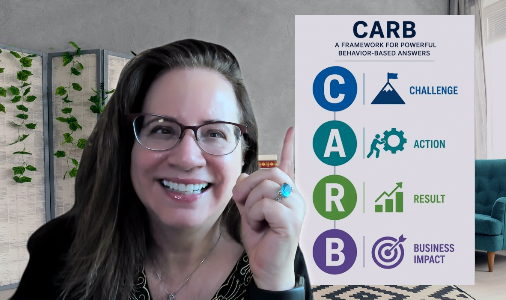

Beyond STAR: Use CARB to Answer Behavior-Based Interview Questions with Business Impact
Most professionals know they should prepare stories for an interview.
They also know they will probably hear questions like:
“Tell me about a time you handled a challenge at work.”
“Describe a time you had a conflict with a coworker, manager, or client.”
“Tell me about a time you had to work under pressure.”
“Tell me about a time you made a mistake. What did you learn?”
These are behavior-based questions, and they are popular for a reason. Employers know that past behavior is often one of the best predictors of future behavior. They are not only listening for what happened. They are listening for how you think, how you communicate, how you solve problems, and how you contribute to the organization.
That is why a rambling answer can hurt you, even when the story itself is strong.
A good story needs structure.
Many people are taught to use the STAR method: Situation, Task, Action, Result. STAR is useful, but for many professional and executive-level interviews, I like an even more business-focused structure:
CARB.
CARB stands for:
Challenge
Action
Result
Business Impact
It is simple, memorable, and especially helpful when you want to sound strategic, concise, and results-oriented.
Why CARB Works
Behavior-based interview answers often go wrong in one of three ways.
Some candidates spend too much time on background. They explain the company, the department, the project, the timeline, the people involved, the history of the issue, and by the time they get to the point, the interviewer has already lost track.
Other candidates describe what “we” did but never make their own contribution clear. The answer may sound collaborative, but the interviewer is left wondering, “What was your role?”
Still others give a decent story but stop too soon. They explain what happened, but they do not explain why it mattered.
CARB helps prevent all three problems.
It keeps the answer focused on the challenge, the candidate’s specific action, the outcome, and the larger value to the business.
That last piece, business impact, is what often separates a good answer from a stronger one.
C: Challenge
Start with the challenge.
Not the entire backstory. Not the organizational history. Not every detail leading up to the event.
The challenge is the problem, tension, opportunity, or obstacle that made the situation worth discussing.
For example:
“We were evaluating whether to enter a new market, but the data was incomplete and stakeholders had different opinions about the size of the opportunity.”
Or:
“We had a major client presentation coming up, and two departments disagreed on the recommendation we should make.”
Or:
“I was asked to prepare analysis for senior leadership on a tight deadline, and the challenge was determining which information was truly decision-critical.”
A strong challenge gives the interviewer a reason to care. It shows that the situation mattered.
For professional roles, especially in strategy, leadership, project management, consulting, sales, operations, or finance, good challenges often involve ambiguity, competing priorities, difficult stakeholders, limited data, time pressure, or meaningful business risk.
A: Action
Next, explain what you did.
This should usually be the largest part of the answer.
The interviewer wants to understand your thinking and your behavior. What steps did you take? What did you decide? How did you communicate? How did you influence others? How did you move the work forward?
This is also where many candidates weaken their answers by saying “we” too often.
There is nothing wrong with giving credit to the team. In fact, you should. But the interviewer is evaluating you, not the entire team.
A useful balance is:
“My role was…”
“I led…”
“I analyzed…”
“I partnered with…”
“I recommended…”
“I worked with the team to…”
For example:
“My role was to structure the analysis, identify the key assumptions, gather input from sales and finance, and turn the findings into a recommendation leadership could act on.”
That sentence makes ownership clear without sounding self-centered.
The action section should not be a list of tasks. It should show judgment. Instead of saying, “I built a spreadsheet,” explain the thinking behind it.
Better:
“I built a model to compare three scenarios, but the most important part was identifying which assumptions would actually change the decision.”
That sounds more strategic.
R: Result
Then, give the result.
What happened?
Was the recommendation accepted? Was the client retained? Did the project move forward? Did the team meet the deadline? Did the process improve? Did the conflict get resolved? Did leadership make a decision?
Whenever possible, make the result specific.
For example:
“The recommendation was approved.”
“We delivered the presentation on time.”
“The client renewed.”
“The new process reduced turnaround time.”
“The analysis helped secure investment for the initiative.”
If you can use numbers, use them. Numbers help make the result concrete.
But sometimes you cannot share confidential information. In that case, you can still be specific without revealing sensitive details.
For example:
“While I can’t share the exact figures, the recommendation was adopted and used to guide the next phase of investment planning.”
That is much stronger than, “It went well.”
B: Business Impact
The final step is business impact.
This is the “so what?”
The result tells what happened. The business impact explains why it mattered.
For example:
Result:
“The recommendation was approved.”
Business impact:
“That allowed the company to move forward in a growth area, allocate resources more confidently, and align the leadership team around the same strategic priorities.”
Here is another example.
Result:
“We resolved the disagreement and completed the project on time.”
Business impact:
“That prevented delay, improved stakeholder trust, and gave the client a clearer, more unified recommendation.”
The business impact does not always have to be dramatic. It may involve better decision-making, reduced risk, improved retention, stronger alignment, increased revenue, faster execution, better customer experience, or more efficient use of resources.
What matters is that you do not leave the interviewer to figure it out.
You connect the dots.
CARB in Action
Here is a simple example.
Question:
“Tell me about a time you handled a challenge at work.”
Answer:
“One challenge I handled was a market expansion analysis where the opportunity looked promising, but the available data was incomplete, and different stakeholders had different assumptions about the potential value.
My role was to bring structure to the decision. I identified the key questions leadership needed answered, gathered internal sales and customer data, reviewed external market information, and built a set of scenarios to show the potential upside and risks. I also met with stakeholders across several functions to pressure-test the assumptions before making a recommendation.
The result was that leadership had a clearer view of the opportunity and was able to make a more confident decision about whether and how to move forward.
The business impact was that the company avoided making a decision based on opinions alone. We created a more disciplined way to evaluate the opportunity, align stakeholders, and prioritize resources.”
Notice what this answer does.
It is structured, but it does not sound robotic. It shows analysis, collaboration, communication, and business judgment. It also ends with impact, not merely activity.
Using CARB for Common Behavior-Based Questions
For a challenge question, focus on ambiguity, complexity, or obstacles.
For a conflict question, focus on stakeholder alignment, listening, and finding the business issue beneath the disagreement. Avoid making the other person sound unreasonable. A strong answer might begin, “The conflict was not personal. It was a difference in assumptions about the best path forward.”
For a pressure question, focus on prioritization and judgment. The point is not to prove that you worked late. The point is to show that you knew how to separate what was essential from what was merely nice to have.
For a mistake question, choose a real but non-fatal mistake. Own it. Explain what you learned. Then show how your behavior changed. A strong mistake answer is not about perfection. It is about self-awareness and growth.
For example:
“The mistake was not in the analysis itself. The mistake was that I waited too long to involve the stakeholders who would ultimately need to act on the recommendation. Since then, I pressure-test assumptions earlier, especially when a recommendation affects resources, ownership, or incentives.”
That kind of answer shows maturity.
A Simple Way to Prepare
Before an interview, do not try to memorize answers to 50 possible questions.
Instead, prepare several strong CARB stories.
You might need a story for each of the following situations:
- handling ambiguity or a challenge
- dealing with conflict or creating stakeholder alignment
- working under pressure
- showing leadership or influence
- learning from a mistake
- accomplishing something measurable
Then practice adapting those stories to different questions.
The goal is not to sound rehearsed. The goal is to sound ready.
Final Thought
Behavior-based interview questions are not asking for a chronology of events.
They are asking for evidence.
Evidence that you can think clearly, take action, and get results.
Evidence that you understand how your work affects the business.
CARB helps you provide that evidence in a way that is clear, concise, and compelling.
Challenge. Action. Result. Business Impact.
That structure can turn an ordinary interview answer into a business story that helps the interviewer see your value.