
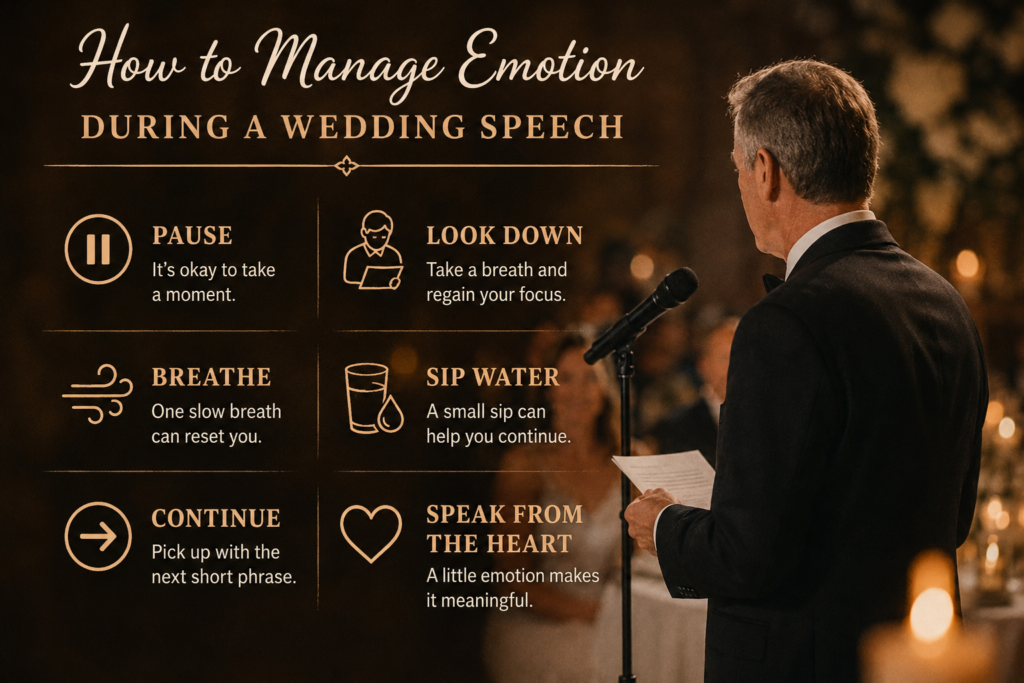
Giving a wedding speech can be a wonderful honor, and one of the most emotional speaking moments many people will ever face. Whether you are the father of the bride, father of the groom, best man, maid of honor, or a close friend, you may be less worried about what to say than about whether you will be able to get through it without getting overwhelmed.
That is a very normal concern.
The good news is that you do not need to eliminate emotion. In fact, a little emotion often makes a wedding speech more genuine and meaningful. The real goal is to manage emotion well enough to stay focused, composed, and able to continue.
If you are wondering how to manage emotion during a wedding speech, here are some practical strategies that can help.
Start by accepting that emotion is not failure
One of the biggest mistakes people make is thinking they have to deliver a wedding speech like a flawless performance. But that is not what guests are hoping for. They are not looking for perfection. They are looking for sincerity.
If your voice catches for a moment or you need to pause, that does not ruin the speech. It often makes the moment feel more real. The audience is usually with you. They understand what the day means.
Instead of telling yourself, “I cannot get emotional,” a better mindset is, “If I get emotional, I know how to recover.”
That small shift can take away a lot of pressure and help you manage emotion more effectively.
Know your emotional trigger lines
Before the wedding, look through your speech and identify the places most likely to affect you.
These are often lines about how proud you are, how much you love your child, what it means to welcome someone into the family, or your hopes for the couple’s future. Sometimes it is not the obvious line. It may be a short sentence that carries years of meaning.
Once you know where those moments are, you can prepare for them. Those lines are not problems to avoid. They are places to handle with care.
You may even want to mark them in your notes so they do not surprise you.
Do not think in paragraphs, think in phrases
When people get emotional, they often start feeling overwhelmed by the whole speech. They look at a large block of text and think, “I cannot get through all of this.”
That is why it helps to break your speech into short thought-units.
Instead of trying to say an entire paragraph, focus only on the next phrase.
For example:
“I’ve always been proud to be your dad.”
Pause.
“I am amazed, but not surprised…”
Pause.
“At the woman you have become.”
This makes the speech feel more manageable. You are not trying to climb the whole mountain. You are simply taking the next step.
Have a simple plan for managing emotion in the moment
If you feel your throat tighten, your eyes well up, or your mind go blank, do not rush. Do not try to force your way through. That usually makes things worse.
Use a simple recovery sequence:
Pause.
Look down at your notes.
Take one slow breath.
Sip water if needed.
Continue with the next short line.
That pause may feel long to you, but it usually does not feel long to the audience. To them, it often feels natural and heartfelt.
And if you need a sentence to help you reset, something simple works well:
“Excuse me, I want to say this well.”
Or:
“I knew this part might get me.”
A calm reset is far better than apologizing repeatedly or trying to rush through tears.
Use your body to help manage emotion
Emotion is not only mental. It shows up physically. Your throat tightens. Your breathing gets shallow. Your shoulders rise. Your voice becomes thinner or shakier.
That is why physical grounding matters.
Before you begin, plant both feet firmly on the floor. Let your shoulders relax. Take a slow breath out. Hold your notes low and steady. Avoid locking your knees or gripping the podium too tightly.
If your body settles, your voice often settles with it.
You can also remind yourself to slow down, especially on meaningful lines. When people are emotional, they often speed up without realizing it.
Be strategic about eye contact
Eye contact is important, but during a wedding speech, it can also trigger more emotion.
If looking directly at your daughter, son, spouse, or the couple makes you much more emotional, you do not have to force it during every key line. You can choose your moments.
For lighter or more humorous sections, look up more often. For the most emotional lines, it may help to glance at your notes first, deliver the line, and then look up once you feel more composed.
This is not a sign of weakness. It is smart preparation.
Practice the high-risk parts, not only the whole speech
Many people assume they need to rehearse the full speech over and over. That can help, but if time is limited, focus especially on the parts most likely to trip you up.
Practice your opening, because starting strong builds confidence. Practice the most emotional section, because that is where you want the most control. Practice the closing toast, because you want to end cleanly and warmly.
Those sections matter more than a perfect run-through of every word.
Keep your setup simple
On the day of the wedding, make things as easy on yourself as possible.
Bring a printed copy of your speech in a readable font, and staple the pages so they stay in order. Use your final version, not one filled with last-minute edits and scribbles. If you need reading glasses, bring them. It can also help to put a short checklist at the top of your notes so you do not forget anything you want with you at the lectern, such as water for sipping, a wine or champagne glass for the toast, your glasses, or any small prop you plan to use.
If you have time, check out the speaking area before it is your turn. Will you be using a lectern or standing in the open? Will there be a microphone, and can you test it ahead of time? Is there a place to set down your water and glass? Do you know where the couple and other important people you may mention will be seated? The more familiar the setup feels, the easier it will be to stay calm, focused, and ready when you begin.
Remember what your job really is
When people worry about managing emotion during a wedding speech, they sometimes start thinking their job is to perform well. That mindset can create more pressure than necessary.
A better mindset is this: your job is to honor the couple.
You are not there to impress the room. You are there to speak from the heart, share something meaningful, and celebrate the moment. That perspective tends to calm people down and bring them back to what matters.
Final thought
If you get emotional during a wedding speech, that does not mean the speech is falling apart. It means the moment matters.
The goal is not to sound untouched. The goal is to manage emotion well enough to stay grounded and continue.
So if emotion rises, pause. Breathe. Look down if needed. Take a sip of water. Then continue with the next line.
That may not ruin the speech. It may be the moment that makes it unforgettable.