When people prepare a presentation, they usually start with their topic.
Leadership.
Communication.
AI.
Strategy.
And that makes sense. You need something to talk about.
But focusing on your topic is also where many presentations start to lose impact.
Because your audience isn’t there for your topic.
They’re there for what the topic means for them.
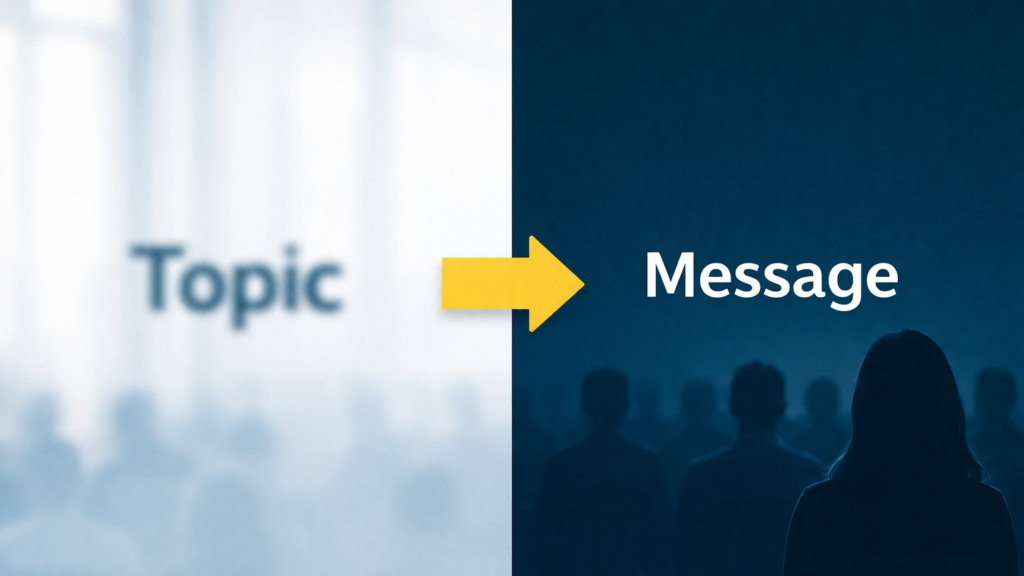
The Difference Between a Topic and a Message
A topic is what you’re talking about.
A message is what your audience walks away with.
That may sound subtle, but the difference is significant.
Compare these two openings:
“I’m going to talk about leadership.”
Versus:
“If you want your team to perform better, you need to reduce decision fatigue.”
Same general subject.
Very different experience for the audience.
In the first, they’re thinking:
“Okay… where is this going?”
In the second, they’re thinking:
“That’s relevant to me.”
“That’s something I can use.”
One is general.
The other is specific, useful, and actionable.
Why Clarity Matters More Than Coverage
Many speakers try to cover their topic thoroughly.
They want to be helpful. Complete. Accurate.
But when everything feels important, nothing stands out.
Clarity isn’t about saying more.
It’s about making one idea clear enough that your audience knows what to do with it.
When your message is clear, something shifts.
People stop just listening.
They start thinking:
“What does this mean for me?”
And more importantly:
“What should I do next?”
Clarity drives action.
Your Message Starts with Your Audience
A strong message isn’t just about your expertise. It’s about your audience, what matters to them, what they’re dealing with, and what they already know.
The same topic delivered to a different audience should lead to a different message.
For example, take the topic of communication skills.
If your audience is senior leaders, your message might be:
“Clear communication reduces misalignment and speeds up decision-making.”
If your audience is early-career professionals, your message might be:
“Strong communication skills help you get noticed and advance your career.”
Same topic. Different audience. Different message.
That’s what makes a message relevant, and relevance is what makes it land.
A simple way to check this is to ask:
- Why should they care?
- What matters most to them?
- What do they already know?
If you can’t answer those clearly, your message will likely stay at the topic level.
A Simple Tool: Think, Feel, Do
Once you’re clear on your audience, the next step is to sharpen your message.
Ask yourself:
What do I want my audience to think, feel, or do?
This helps you move from a general topic to a message with direction.
For example, if your topic is public speaking:
You might want your audience to:
- Think: “I can speak with confidence.”
- Feel: motivated to try
- Do: speak up in a meeting or volunteer to present
Now your message becomes clearer:
“Developing your speaking skills gives you the confidence to share your ideas and have an impact.”
That’s no longer just a topic.
It’s a message designed to lead somewhere.
A Small Shift That Makes a Big Difference
If you’ve ever given a presentation that felt solid—but didn’t lead anywhere, this may be why.
You had a topic.
But not a clear message.
The shift from topic to message is one of the simplest—and most powerful—ways to increase your impact as a speaker.
Before your next presentation, try this:
Instead of asking, “What am I going to talk about?”
Ask:
“What do I want my audience to walk away thinking, feeling, or doing?”
That one shift can change how your audience experiences your entire talk.
The shift from topic to message is one of the core ideas behind my book, The Clarity Code: How to Communicate Complex Ideas with Simplicity and Power. If you want practical ways to make your ideas clearer, more relevant, and more actionable, that’s exactly what the book is designed to help you do.