I recently tried a fun AI prompt I came across from Kim Komando. The prompt asked AI to write the opening page of my memoir, but with one important twist: don’t start with childhood. Start with a single moment that captures who I actually am.
That instruction alone makes the prompt smarter than a lot of the communication we hear every day.
Most people, when asked to tell their story, start too far back and include too much. They begin with background, history, credentials, context, and explanation. The result may be accurate, but it is often not memorable.
This prompt did something different. It asked for a moment.
And that is what caught my attention.
When I used it, the memoir opening that came back focused on a scene that felt deeply familiar to me: sitting at my computer, about to begin a Zoom coaching session, surrounded by notes, drafts, ideas, and too many open tabs, getting ready to help a client find clarity.
Before I talk about the communication lessons, here’s part of what it generated for me:
The Woman Who Could Turn Static Into Signal
The square of my own face hovered in the corner of the screen, waiting for me to begin.
It was one of those ordinary modern stages I have stepped onto thousands of times, a Zoom window, a ring light, a client on the other side of the country, and yet the moment still carried that tiny electric charge I have always felt before speaking. Not fear exactly. More like readiness. Like my whole life had trained me to do this one strange thing: enter a room full of noise, uncertainty, nerves, ambition, ego, hope, and somehow help people find the clear sentence buried inside all of it.
My desktop was crowded with evidence of my mind. Notes for a coaching session. A draft chapter of The Clarity Code. A Toastmasters email I still needed to send. A Canva tab with a banner half-finished. A text from family. A calendar that looked like it belonged to three different women instead of one. Somewhere in that digital clutter was the shape of my life, not neat and color-coded, but alive. Busy. Meaningful. A little too full. Completely mine.
On the screen, my client adjusted his camera and gave me the look I know well, smart, capable, accomplished, and quietly worried that none of those things will matter if he cannot make people understand him.
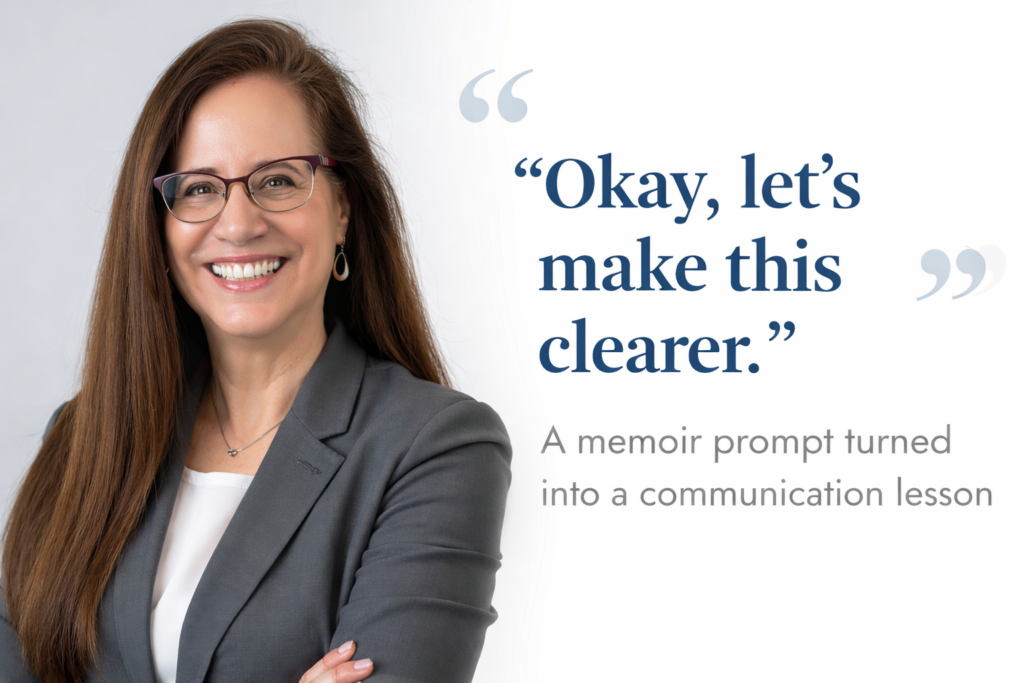
“Okay,” I said, leaning in. “Let’s make this clearer.”
What struck me was not just that the writing sounded polished. It was that it chose a moment that genuinely felt like me.
And that is what makes this such a useful communication exercise.
Good communication starts with a telling moment
Whether you are introducing yourself, writing a bio, giving a presentation, leading a meeting, or answering “Tell me about yourself” in an interview, one of the most effective things you can do is choose a moment that reveals something true about you.
A moment gives people something to see.
A summary gives people something to process.
That is a big difference.
If I tell you, “I’m a communication coach, author, and speaker who helps people communicate complex ideas clearly,” that is true. But if I show you a moment when I am leaning into a Zoom screen, telling a client, “Okay, let’s make this clearer,” you can picture it. You can feel it. You can understand it faster.
Specificity creates connection.
This is one reason stories work so well in communication. A well-chosen story or snapshot helps people grasp meaning more quickly than a long explanation. It reduces mental load. It creates interest. It gives abstract ideas a human form.
Identity is best revealed through action
One of the things I liked most about the generated memoir was that it did not simply describe my values. It showed them.
It did not say, “Diane values clarity.”
It showed me helping someone get clear.
That is a much stronger form of communication.
The same principle applies in professional settings all the time. If you want people to understand your leadership style, your strengths, your brand, or your message, do not rely only on labels. Show what those qualities look like in real life.
Instead of saying you are collaborative, describe a moment when you brought people together around a shared goal.
Instead of saying you are resilient, describe a moment when you had to adapt, recover, or keep going.
Instead of saying you are audience-focused, show how you adjusted your message so others could understand it.
In communication, verbs usually beat adjectives.
Better prompts often lead to better thinking
The other lesson here is about AI itself.
The power of the exercise was not just in the writing it generated. It was in the prompt design.
“Write the opening page of my memoir” is interesting.
But “Write the opening page of my memoir. Make it dramatic. Make it true. Don’t start with my childhood. Start with a single moment that captures who I actually am” is much better.
That prompt creates focus, tension, and direction.
In other words, it does exactly what strong communication should do.
This is one reason I often encourage clients to use AI not just to generate content, but to help them discover their message. A strong prompt can uncover patterns, themes, and truths you may not have articulated yet. It can help you see yourself from a different angle. It can also show you which details are vivid and memorable, and which ones are just informational clutter.
AI is not replacing reflection in a case like this. It is supporting it.
Even the book cover reinforced the lesson
After the memoir opening was generated, I took the experiment one step further and asked for a book cover.
That part was amusing at first, because the first version got key details wrong. It did not use my actual name or image. Once I corrected it and provided my own headshots, the result became much more personal and much more interesting.
That, too, is a communication lesson.
Communication gets stronger when it becomes more specific and more accurate.
That applies to book covers, but it also applies to presentations, stories, websites, bios, and branding. Generic content may be polished, but it rarely feels fully alive. The more your communication reflects something real, your actual face, your actual voice, your actual point of view, the more it resonates.
The cover was playful, but the lesson behind it was serious: clarity and connection improve when the message is grounded in what is true.
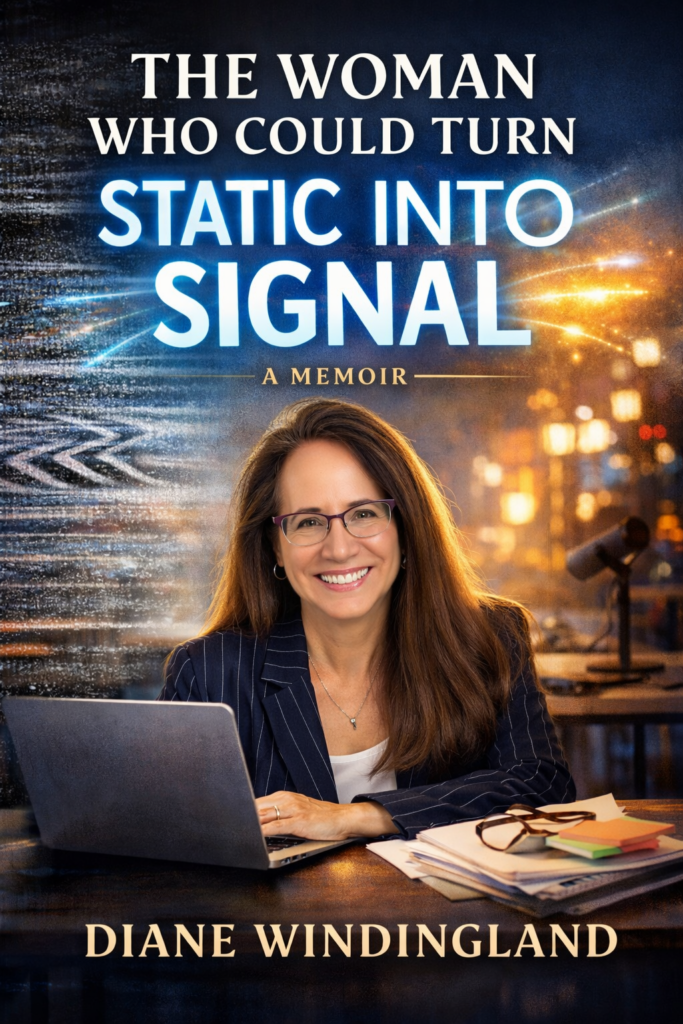
One important note: this result didn’t come out of nowhere. I’ve used ChatGPT extensively for the past three years, for everything from blog posts and books to customized coaching programs and personal correspondence. It knows a lot about my voice, my work, and the themes I return to. So if you try this yourself and the first result feels more generic, that doesn’t mean the exercise failed. It may simply mean you need to give the tool more context and refine from there.
That said, the exercise still highlights an important truth about communication: people connect more quickly with a vivid moment than with a long summary.
What this means for everyday communication
You do not need to write a memoir to use this idea.
You can apply it almost anywhere.
If you are updating your About page, ask yourself: what moment best captures the work I really do?
If you are preparing a presentation, ask: Which scene or story would help people understand my message more quickly?
If you are introducing yourself in a meeting or interview, ask: what brief example reveals who I am better than a list of titles?
If you are using AI to help with writing, ask: Have I given it enough direction to produce something specific, meaningful, and true?
These are not memoir questions. They are clarity questions.
And often, the fastest route to clarity is not more information. It is a better frame.
Try this yourself
If you want to experiment with this, try the memoir prompt for yourself:
Based on everything I’ve told you about myself, write the opening page of my memoir. Make it dramatic. Make it true. Don’t start with my childhood. Start with a single moment that captures who I actually am. Give it a title I’d never pick for myself but would secretly love.
Then look beyond whether you “like” the writing.
Ask yourself:
What moment did it choose?
What theme showed up?
What felt true?
What details created energy?
What might this reveal about how I should introduce myself, tell my story, or open a presentation?
You may end up with more than a memoir opening.
You may end up with a clearer message.